
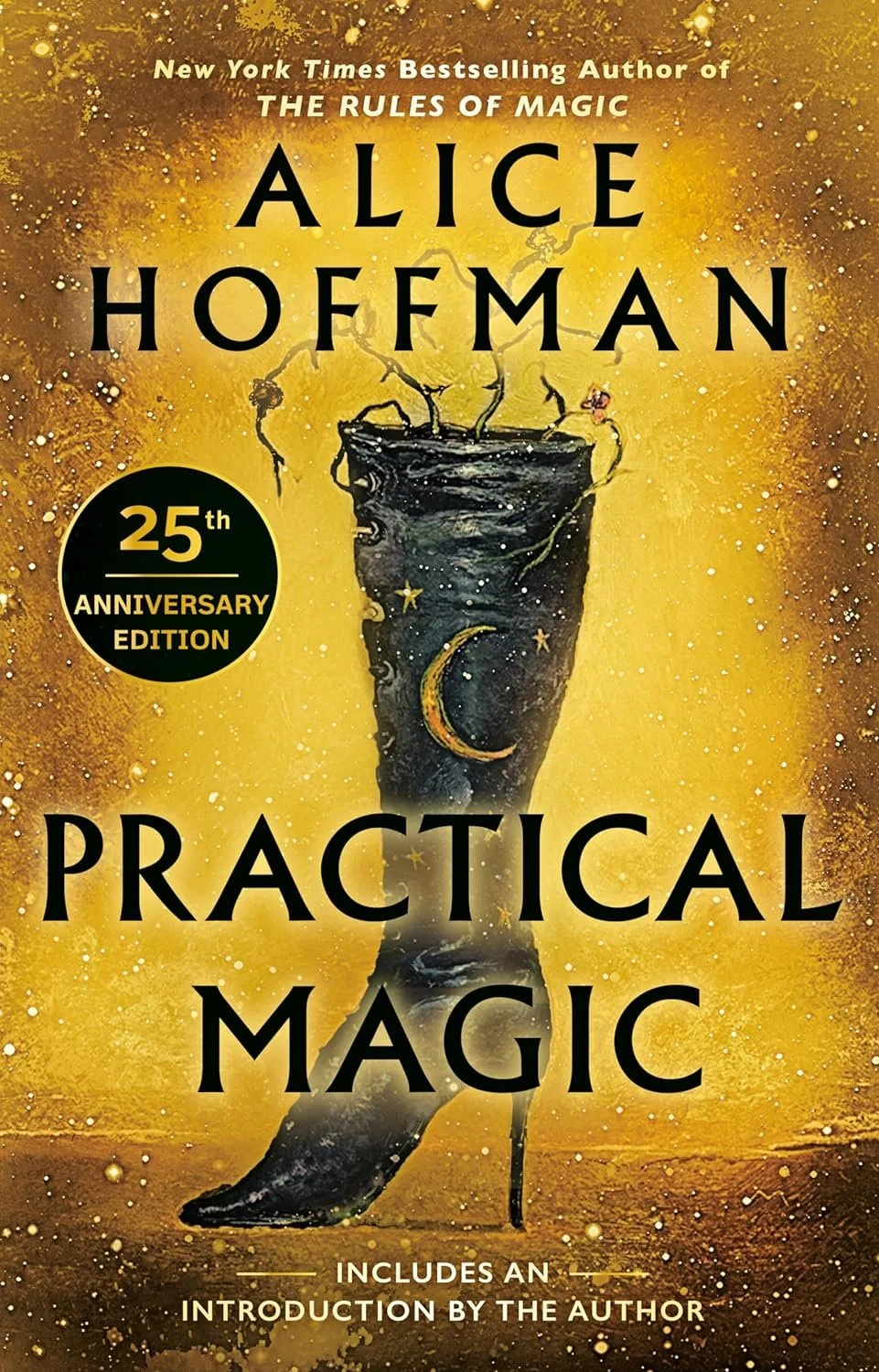
Practical Magic by Alice Hoffman
⭐⭐⭐
For more than two hundred years, the Owens women have been blamed for everything that has gone wrong in their Massachusetts town. Gillian and Sally have endured that fate as well: as children, the sisters were forever outsiders, taunted, talked about, pointed at. Their elderly aunts almost seemed to encourage the whispers of witchery, with their musty house and their exotic concoctions and their crowd of black cats. But all Gillian and Sally wanted was to escape. One will do so by marrying, the other by running away. But the bonds they share will bring them back—almost as if by magic...
I finally picked up Practical Magic by Alice Hoffman. This is a book that has become almost synonymous with autumn reading recommendations and witchy vibes. As someone who has seen and enjoyed the movie adaptation, and with the release of the sequel this past September, I was curious to see how the original story compared.
While the movie centers much of its story around Sally Owens, the novel focuses more on the Owens family as a whole. Love, grief, and the bonds between generations of women take center stage. Alice Hoffman's writing is beautiful, and her talent shines on nearly every page. Unfortunately, while I appreciated much of what the book was doing, I never found myself emotionally immersed in the story. By the end, I respected the novel more than I actually enjoyed reading it.
Characters: 8
The characters were easily one of the strongest aspects of the book for me. One thing that surprised me was how much growth the Owens women experience over the course of the novel. Hoffman gives her characters room to evolve, make mistakes, and discover who they are, and who they want to be.
Atmosphere: 9
If there is one thing Practical Magic absolutely nails, it's atmosphere.
I don't have pages and pages of notes about the world-building because Hoffman doesn't spend much time explaining how her magic works or constructing an elaborate magical system. Instead, she creates a mood. The novel feels like stepping into a small Massachusetts town where everyone knows everyone else's business, and rumors can become truth simply because they've been repeated for generations.
What I appreciated most was that Hoffman doesn't romanticize small-town life. So many books lean heavily into the cozy aspects of living in a tight-knit community, but Practical Magic explores the darker side as well. The Owens family spends much of the novel as outsiders, subjected to gossip, suspicion, and judgment.
That tension gives the setting a unique feel. The town isn't warm and welcoming, nor is it outright hostile. Instead, it exists in that uncomfortable middle ground where everyone is constantly watching, talking, and making assumptions.
Writing: 10
Alice Hoffman’s writing is, without question, the highlight of Practical Magic.
There are books where you fall in love with the story, and there are books where you fall in love with the way the story is told. For me, Practical Magic belongs firmly in the second category. Even during the slower sections of the novel, I found myself appreciating Hoffman's prose and the way she brought the Owens family to life.
Her writing has a dreamlike quality that perfectly suits the story she wants to tell. The line between reality and magic is often blurred, creating an atmosphere that feels more like a memory or a family legend than a traditional fantasy novel. Personally, I loved it.
Plot: 7
I have a feeling my experience with the movie made scoring the plot a little more complicated than it otherwise would have been.
One of the biggest differences between the book and the film is how much broader the story is. While the movie places much of its focus on Sally and her grief and finding love again, the novel treats the entire Owens family as the heart of the story. I actually preferred this aspect of the book. The relationships between the sisters, the aunts, the daughters, and even the men who become entwined with the family all contribute to a story that feels much richer.
Unfortunately, there were several plot developments that didn't quite work for me.
The biggest issue came from the storyline involving Gillian's abusive boyfriend, Jimmy. After his death, the sisters make a series of decisions that felt inconsistent with their concerns and motivations. I found myself questioning why they were handling the situation in certain ways when other options seemed more logical. The plot still moves forward, but there were moments where I struggled to connect the characters' actions with the reasoning behind them.
In the end, I found the story more interesting in concept than in execution.
Intrigue: 3
I wish I had more positive things to say here, but the truth is that I was bored through large portions of this book.
That's not to say nothing was happening. There are romances, family drama, questions about curses, a murder, and plenty of conflict. On paper, Practical Magic contains all the ingredients of a story that should have kept me completely hooked. Unfortunately, the execution never created much interest for me.
I kept waiting for certain plotlines to create a stronger sense of suspense, especially after Gillian's boyfriend died. Instead, the story often drifted from one moment to the next without generating the kind of tension that makes it difficult to put a book down.
Ironically, my investment in the characters is probably the reason I finished the novel. I cared enough about the Owens family to see how their stories ended, even when I wasn't particularly engaged by the journey itself.
Ultimately, Practical Magic is a book I admired more than I devoured. While the writing and atmosphere kept me reading, the story itself never managed to capture my full attention, making intrigue one of the weakest categories for me.
Logic: 7
Logic was an interesting category for me because while there were definitely moments that made me raise an eyebrow, I never felt like the story contradicted itself.
There are several decisions throughout the novel that didn't entirely make sense to me, particularly in the aftermath of Jimmy's death. More than once, I found myself wondering why the characters chose one course of action over another. However, those moments never felt like plot holes so much as choices I personally didn't agree with.
What kept this score from dropping lower is that Practical Magic remains remarkably consistent in its own rules and themes. The story establishes early on that it exists in a space where reality and magic overlap, and it never abandons that premise. Even when I questioned certain decisions, I could usually trace them back to the characters' beliefs or fears.
I was especially intrigued by the way magic is handled throughout the novel. The book never outright confirms that the Owens women are witches. It is heavily implied, and the townspeople certainly believe it, but Hoffman leaves just enough ambiguity for readers to interpret events however they choose. Are the Owens women genuinely magical, or are they the victims of generations of superstition and self-fulfilling prophecy? The novel never provides a definitive answer.
The same ambiguity extends to the men who fall in love with the Owens women. Their devotion often feels intense enough to suggest some kind of enchantment, yet no love spell is ever cast. In fact, from what I could tell, the only characters who intentionally practice magic are the aunts.
For me, that ambiguity was the reason why I didn’t really enjoy the book that much. More on that in the enjoyment category. Even when individual plot points left me unconvinced, the story's internal consistency remained intact.
Enjoyment: 4
This is one of those books that I can appreciate while also acknowledging that it simply wasn't for me.
I didn't hate Practical Magic. In fact, there were several aspects of the novel that I genuinely admired. The writing is beautiful, the atmosphere is memorable, and the Owens family is compelling. If I were rating the book solely on craftsmanship, my score would probably be much higher.
The problem is that admiration and enjoyment aren't always the same thing.
Despite my investment in the characters and my appreciation for Hoffman's writing, I spent much of this book feeling detached from the story. The pacing often felt slow, and there were long stretches where I was reading more out of obligation than excitement. I wanted to know how everything would end, but I rarely felt eager to pick the book back up.
By the time I reached the end, I was glad I had read it, but I wasn't left with the desire to immediately revisit the story. For me, Practical Magic falls into the category of books I'm happy to have experienced once, but don't see myself returning to again.
Ultimately, this was a mixed reading experience. I found a lot to admire, but not a lot to love. And while I can absolutely understand why so many readers consider this a beloved classic, it never cast quite the same spell on me.
Final Verdict
Practical Magic is one of those rare books that left me with conflicting feelings. On one hand, Alice Hoffman's writing is absolutely stunning. The atmosphere is rich, the characters are memorable, and the story explores love, family, grief, and belonging. On the other hand, I spent much of the novel wanting more from the story itself.
I can completely understand why this book has remained beloved for decades. Hoffman's focus isn't on action or suspense. Instead, she creates a story that feels like a memory.
At the end of the day, Practical Magic is a beautifully written novel that I respect far more than I enjoyed. I'm glad I finally read it; however, it's not a story I'll find myself revisiting.
Rating: 6.9/10
A beautifully written, atmospheric family saga that showcases Alice Hoffman's talent, even if its slow pace and low intrigue kept it from truly enchanting me.
